Monday, June 7, 2010

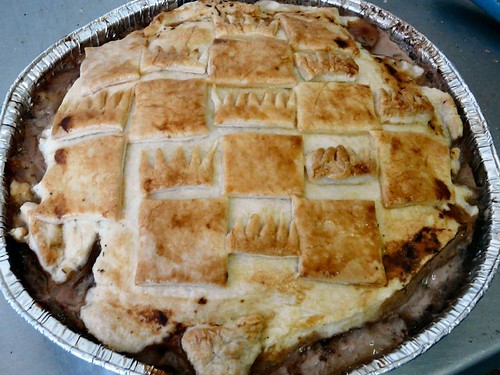
Renaissance Duck Pies

This recipe for duck pie has few ingredients and may seem a little odd, using the juice but not flesh of onions as a seasoning. These were so good that back in the kitchens we spent quite a while trying to figure out an excuse not to send them out to be eaten at all... we wanted to keep them all for ourselves!

The hardest thing about the recipe is tracking down Verjuice. Verjuice is unfermented wine grape juice and is a common ingredient used in medieval and renaissance cooking. It has come back into modern cookery quite recently and adds a very special taste to dishes. In Australia, Maggie Beer produces verjuice commercially - sadly I have yet to find a supplier here in Europe.

At a total pinch you could use a very mild vinegar - I had a bottle of verjuice that a friend sent me and with experimentation, I made up a mixture of grape juice and wine vinegar and was able to get something that resembled verjuice for the feast, as my little bottle certainly didn't contain enough to feed 138 people!

Somewhat unusually for an ancient 'receipt', this recipe does have some guidance as to quantities of ingredients. My version used this as a guide but I made it with duck meat rather than a whole bird.

To bake a Mallard (The Good Housewife's Jewell 1596)

Take three or foure Onyons, and stampe them in a morter, then straine them with a saucer full of vergice, then take your mallard and put him into the iuyce of the sayde onyons, and season him with pepper, and salte, cloves and mace, then put your Mallard into the coffin with the saide juyce of the onyons, and a good quantity of Winter-savorye, a little tyme, and perselye chopped small, and sweete Butter, so close it up and bake it.

Take three onions and food process them. Pour 1/3 of a cup of verjuice into the food processor, then strain through muslin to extract the juices (I recommend setting aside the onions to make into onion soup). Take 1/2 a kilo of duck meat, chopped into pieces and marinate in the onion juice, with pepper, salt, 1/4 tsp ground mace and a pinch of ground cloves. I couldn't find fresh winter savory, so used dried - about 1/2 a tablespoon, then a teaspoon of thyme and a tablespoon of parsley.

Bake in a closed pie shell, or as little individual pies. Eat while piping hot.
Monday, August 6, 2007

Fine Cakes - English spiced shortbread

This recipe is from "The Widowes Treasure" which was published in 1639. It is pretty much a spiced shortbread, but made, interestingly, with pre-baked flour. This gives them a really beautiful crisp texture.

The original version:
Take a quantity of fine wheate Flower, and put it in an earthen pot. Stop it close and set it in an Oven, and bake it as long as you would a pasty of Venison, and when it baked it will be full of clods.Then searce your flower through a fine sercer.

Then take clouted Creame or sweet butter, but Creame is best: then take sugar, cloves, mace, saffron and yolks of eggs, so much as wil seeme to season your flower. Then put these things into the Creame, temper all together. Then put thereto your flower. So make your cakes. The paste will be very short; therefore make them very little. Lay paper under them.

My version:
1 cup plain flour
90 g butter
1 generous pinch of saffron
3 cloves
1/8 tsp mace
1/4 cup caster sugar
1 egg yolk

Bake flour for 15-20 minutes at 180 degrees, in a closed casserole dish. The flour shouldn't brown, but you will see that it clumps together if you stir it with a spoon.  Allow to cool, then sift.

Grind spices with sugar. Cream butter, sugar/spice and egg yolk till the consistency of thick cream. Fold in flour.  Do not knead the dough. 

I pressed small amounts of this mixture into molds to make flour shapes, which popped out of the mold easily.  One of my apprentices forms them in to small balls and then presses them flat. As the original recipe says, the paste is very short! Bake on baking trays lined with paper for 10-15 minutes at 180 degrees.

*Note: be careful with the mace - depending on the particular mace you have, it can be very strong!

Wednesday, June 18, 2003

Bizcochos - Renaissance Spanish Biscotti

This recipe is from a book by Diego Granado, "Libro del Arte de Cozina", 1599 trans. by Lady Brighid ni Chiarain
Take twelve eggs, and remove the whites from four of them, and with a little orange-flower water beat them a great deal, and grind a pound of sugar, and cast it in little by little, always beating quickly, and cast in flour, or powdered wheat starch, and beat it with force. Having cast in the said flour, when they see that it is necessary, and very fine, and the dough must remain white, just as for fritters, and then cast it in your pots, and carry them to the oven, and when half-cooked remove them, and dust them with well-ground sugar, and cut them to your taste, and return them to the oven, and let them finish baking a second time: and if they wish when they beat them, cast in as much white wine as an eggshell, it will be good.

My version of the recipe (shrunk down somewhat!):

3 eggs
1 egg yolk
2/3 cup sugar
2 cups flour
1/8 tsp orange flower water
1 tsp wine

Preheat the oven to 175 degrees

Beat the eggs, wine and orange flower water till fluffy but not dry. Add the sugar slowly while continuing to beat. Once well blended and dissolved, add 2 cups of flour gradually, continuing to beat. This will make a sticky dough.

Put this into a loaf tin and bake in a moderate oven for about 15 minutes till the loaf is set and firm to the touch but not browned. 

Allow to cool. Slice thinly.

Drop the oven temperature to 140 degrees. Lay the slices of cake on oven trays and put back in the oven for another 10-15 minutes until lightly browned.

 These strongly resemble modern biscotti minus almonds, and are crisp and light and would be great with coffee.